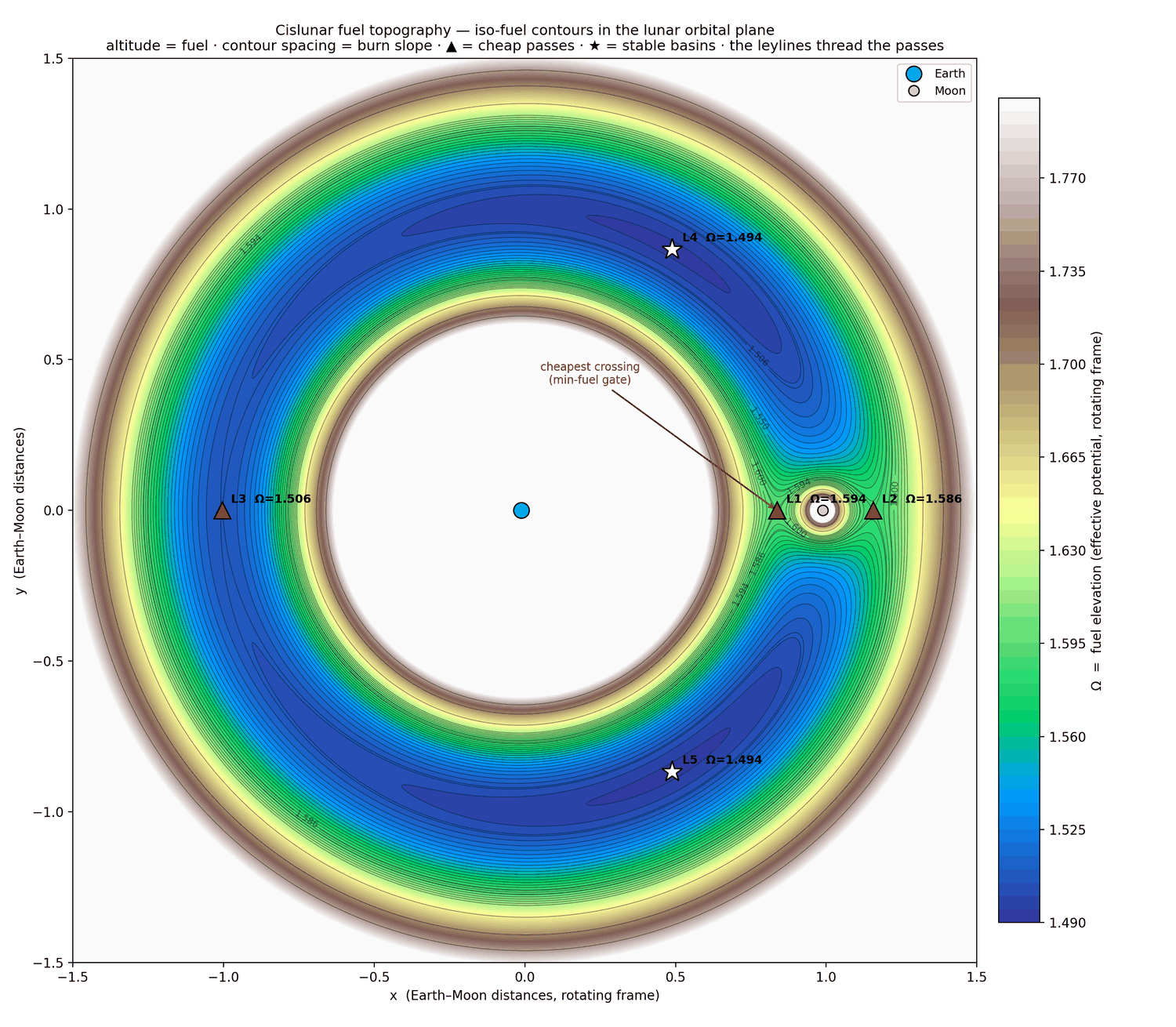
An integrated instrument for cislunar (Earth–Moon) mission analysis. From a single engine, SELENOGRAPH answers the four core questions of cislunar mission design — will an orbit hold and what does it cost to keep; what is the cheapest transfer and when is its window; how many spacecraft can a region hold collision-free; how is a formation coordinated without collision. The same input returns the same assessment, reproducible and auditable, in seconds where conventional case-by-case analysis takes hours to weeks.
The method is published and placed in the public domain (DOI 10.5281/zenodo.20721194). The operational engine is not distributed.
One mission specification — candidate orbits in the Earth–Moon system — in; four deterministic answers out.
| Question | SELENOGRAPH returns |
|---|---|
| REGIME & FUEL | the orbit's stability class and its station-keeping correction interval |
| TRANSFER & WINDOW | the low-energy corridor between two orbits and the exact energy gate it opens below |
| CAPACITY | the structural ceiling on collision-free orbits a region can hold |
| FORMATION | a bounded, scheduled relative-motion plan and its station-keeping budget |
All four are deterministic: the same input returns the same assessment, reproducible from the classical definitions in the preprint — no random sampling, no fitted model, no per-case tuning.
A cislunar region has a hard carrying capacity. As it fills, the fraction of collision-free arrangements does not fade gently — it falls to exactly zero beyond a structural limit. That ceiling is a combinatorial property of the orbital mechanics, computed directly, not a probabilistic risk estimate.
| Result | Value |
|---|---|
| Depot DRO regime | marginal — the lunar-economy band |
| Station-keeping: depot vs. gateway pass | ~150 d vs ~30 d (≈5× cheaper) |
| Transfer-corridor energy gate (Jacobi C) | 3.172 |
| Carrying capacity: collision-free fraction | ~100% → 0% (hard ceiling) |
| Relay formation held collision-free | 29 m/s / 260 d (0 breaches) |
Demonstrated on the canonical Earth–Moon restricted three-body problem (mass ratio μ = 0.01215): a logistics depot with a relay formation in a Distant Retrograde Orbit. Every figure computed, not estimated. Full method, configuration, and results: 10.5281/zenodo.20721194.
View a sample mission analysis — the lunar depot & relay swarm →
Mission designers and operators, lunar-economy ventures (relay, navigation, logistics, depots), cislunar traffic-and-capacity services, and underwriters of cislunar risk: email with your mission and operating context, and a scoped evaluation follows.